6 Hidden Heavy Metal Risks Lurking in Supplements

Supplements are often seen as an easy extension of a healthy lifestyle, a capsule for convenience, a scoop for performance, a tablet for prevention. Yet unlike foods that are eaten occasionally, supplements are typically consumed daily, consistently, and for long periods of time. This makes their safety profile especially important. In recent years, Indian research studies and regulatory investigations have drawn attention to an often-overlooked issue in this space: the presence of trace heavy metals in certain supplement categories.
Table of Contents
Everyday Supplements, Unseen Safety Questions
Supplements have become deeply embedded in everyday health routines across India. Prenatal vitamins are recommended during pregnancy, protein powders are marketed as essential for muscle recovery, omega‑3 capsules are positioned as heart‑protective, and herbal formulations are often taken daily for immunity, digestion, or stress support.
For most consumers, there is an underlying assumption: if a product is legally sold, it must be safe. Yet Indian research, regulatory actions, and investigative journalism over the past decade suggest a more nuanced reality. Trace heavy metals such as lead, mercury, arsenic, and cadmium continue to appear in certain supplement categories, not always due to fraud, but often due to environmental exposure, sourcing practices, and inconsistent quality controls.
This article explores six hidden heavy‑metal risks lurking in supplements, grounded specifically in the Indian context. The aim is not to create fear or distrust in supplements, but to explain where risks actually arise, how Indian regulations address them, and why transparency and verification matter for products consumed daily over long periods.
Risk 1: Contaminated Raw Materials – Nature Doesn’t Filter Heavy Metals
One of the least visible but most significant sources of heavy metals in supplements is the environment itself.
India faces well‑documented challenges with soil and water contamination. Industrial activity, mining, pesticide residues, coal combustion, and groundwater arsenic have all contributed to background heavy‑metal levels in certain regions. Medicinal plants, algae, grains, and oil‑seeds absorb elements present in their growing environment, both nutrients and contaminants.
When these raw materials are harvested for supplements, trace heavy metals can enter the supply chain long before any manufacturing begins.
An Indian analytical study examining commercially available Ayurvedic and herbal formulations detected measurable levels of lead, mercury, cadmium, and arsenic in a significant proportion of products. The researchers concluded that contamination often originated at the raw‑material level rather than from intentional adulteration during formulation.
This finding challenges a common consumer assumption that “natural” automatically means “clean.” Plant‑based green powders, herbal capsules, and algae‑derived supplements may all reflect the environmental conditions in which their ingredients were grown.
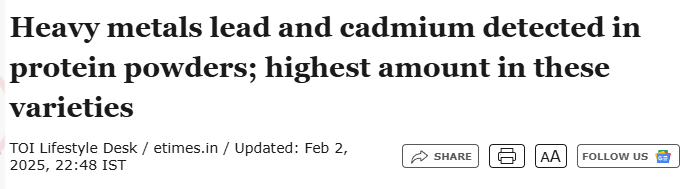
This issue is not limited to academic studies. A Times of India investigation published in 2025 reported detectable lead and cadmium in several plant‑based protein powders sold in India. Experts cited in the article pointed to soil uptake by crops as a primary contributor, especially in plant proteins sourced from regions with environmental contamination.
For consumers, the implication is clear: environmental contamination is upstream, and without testing, it remains invisible.
Risk 2: Traditional & Ayurvedic Supplements – Cultural Trust Meets Modern Exposure
India’s long tradition of Ayurveda and other indigenous systems of medicine carries deep cultural trust. For generations, many formulations were used intermittently, prepared locally, and consumed in small quantities. Today, the landscape has changed. Traditional formulations are:
~ Manufactured at scale
~ Packaged for national and global markets
~ Consumed daily for months or years
This shift increases the importance of contamination control and consistent testing.
A systematic review published in Current Environmental Health Reports examined heavy‑metal contamination in traditional medicines, including Indian Ayurvedic products. The authors reported that a notable proportion contained lead, mercury, or arsenic above recommended safety limits, linking the issue primarily to environmental sourcing and manufacturing practices, rather than consumer misuse or intentional harm.
Another Indian study analysing over‑the‑counter Ayurvedic medicines found that nearly all tested samples contained detectable heavy metals, with several exceeding WHO/FAO limits for lead and mercury. The researchers emphasised that contamination can occur even in products marketed as purely herbal.
Source : NIH : Are Ayurvedic medications store house of heavy metals?
These findings do not invalidate traditional systems of medicine. Instead, they highlight a critical point: heritage does not replace the need for modern safety testing, especially when products are consumed daily or by vulnerable populations such as children and pregnant individuals.
Risk 3: Manufacturing Cross‑Contamination & Quality Control Gaps
Even when raw materials start within acceptable limits, contamination can still occur during manufacturing.
Supplement production often involves:
~ Shared equipment handling multiple raw materials
~ Cleaning protocols that vary between facilities
~ Water sources that may contain trace contaminants
~ Infrastructure that may not meet pharmaceutical‑grade standards
Indian lab audits and academic analyses have documented cases where finished supplements contained higher heavy‑metal levels than their original ingredients, indicating contamination introduced during processing rather than sourcing alone.
This risk is especially relevant in facilities producing multiple product categories, for example, herbal blends alongside mineral or protein supplements where cross‑contamination can occur if controls are insufficient.
The takeaway is straightforward: testing only raw ingredients is not enough. What ultimately matters is what ends up in the finished capsule, tablet, or scoop that consumers take daily.
Risk 4: Fish Oil & Omega‑3 Supplements – When Cost‑Cutting Undermines Purification
Fish naturally accumulate mercury and other contaminants from their aquatic environment. This has long been recognised, and reputable supplement manufacturers address the issue through purification techniques such as molecular distillation.
When applied correctly, purification significantly reduces heavy metals and other pollutants.
However, problems arise when:
~ Lower‑cost fish oil sources are used
~ Purification steps are inconsistently applied
~ Batch‑level contaminant testing is skipped to save costs
In such cases, residual contaminants may remain, not because purification technology fails, but because quality control is compromised.
This distinction is important. Fish oil supplements themselves are not inherently unsafe. The risk emerges when economic pressures are allowed to override verification.
For Indian consumers, the key issue is not avoiding omega‑3 supplements altogether, but choosing products that demonstrate purification effectiveness through independent, batch‑specific testing.
Risk 5: Regulatory Blind Spots & Uneven Transparency
India’s Food Safety and Standards Authority of India (FSSAI) defines permissible limits for heavy metals in supplements and nutraceuticals. Products tested within these limits are considered safe for consumption.
However, regulation in practice has limitations:
~ Routine pre‑market batch testing is not mandatory for all supplements
~ Surveillance is largely post‑market, often triggered by complaints or investigations
~ Public access to laboratory reports is inconsistent across brands
This creates a gap between regulation and consumer visibility. A product may technically comply with standards, yet consumers have little way of knowing whether a specific batch was tested or when.
This is not unique to India, but it is particularly relevant in a rapidly growing supplement market where new brands and formulations appear frequently.
Risk 6: Daily Use, Multiple Products & Cumulative Exposure
Heavy metals are regulated because excessive exposure over time can cause harm. This does not mean that trace amounts within FSSAI limits are inherently dangerous.
The concern arises when:
~ Products exceed permissible limits
~ Multiple supplements are taken simultaneously
~ Exposure continues daily over long periods
Research consistently links chronic high exposure, rather than compliant trace exposure, to cardiovascular, neurological, and metabolic effects. This is why regulatory limits exist and why consistent adherence matters most for products intended for long‑term use.
In India, where many consumers combine protein powders, herbal supplements, multivitamins, and omega‑3s, cumulative exposure makes verification more important than ever.
Health Effects of Heavy Metals: Why Limits Exist
Heavy metals such as lead, mercury, arsenic, and cadmium are regulated in food and supplements for a reason. At elevated or prolonged exposure levels, these metals can interfere with normal biological processes and contribute to adverse health outcomes.
It is important to clarify one point upfront; trace amounts within FSSAI’s permissible limits are considered safe for consumption. Health risks arise primarily when exposure exceeds these limits or accumulates from multiple sources over time.
How Heavy Metals Affect the Body?
Heavy metals do not play a beneficial role in human physiology. When present above safe thresholds, they can:
~ Accumulate in tissues such as the liver, kidneys, bones, and brain
~ Disrupt enzyme function, affecting metabolism and detoxification pathways
~ Increase oxidative stress, which damages cells and accelerates inflammation
Because the body eliminates many heavy metals slowly, chronic exposure matters more than one-time intake.
Specific Health Concerns Linked to Excess Exposure
Scientific research has linked elevated or prolonged exposure to heavy metals with:
Lead
~ Impaired neurological function
~ Reduced cognitive development in children
~ Increased risk of hypertension and cardiovascular issues in adults
Mercury
~ Effects on the nervous system, including memory and coordination
~ Higher risk for pregnant individuals due to fetal neurodevelopment concerns
Arsenic
~ Skin, cardiovascular, and metabolic effects at higher exposure levels
~ Long-term exposure linked to increased cancer risk
Cadmium
~ Kidney dysfunction
~ Bone demineralisation with prolonged exposure
These outcomes are typically associated with exposures above regulatory limits or sustained over long durations, not with compliant products consumed as directed.
Why Daily-Use Supplements Deserve Extra Attention
Supplements differ from many foods in one key way: they are often consumed daily, consistently, and for years.
Even when individual products meet safety standards, risks increase if:
~ Products exceed permissible limits
~ Multiple supplements are taken together
~ Quality control varies between batches
This is why regulators set conservative limits and why consistent testing of finished products is critical, especially for supplements intended for long-term use.
The Bottom Line on Health Risk
Heavy metals are a concern not because they are always present, but because excess exposure over time can compromise health. Regulatory limits exist to prevent this, and products that comply with these limits are considered safe.
The focus, therefore, should not be fear of supplements, but confidence in compliance, supported by transparent testing and responsible manufacturing.
Where Pink Tiger Fits In : Verification, Not Fear
Given the variability in sourcing, manufacturing, and disclosure, the biggest gap in the Indian supplement ecosystem is verifiable transparency.
Pink Tiger was created to address a simple question: does this finished product actually meet safety limits?
When a product is Pink Tiger Verified:
~ Finished batches are tested for heavy metals
~ Testing is conducted through NABL‑accredited third‑party laboratories
~ Results are published openly for consumers to review
This approach does not replace regulation. It complements it by making compliance visible and understandable to everyday consumers.


What Indian Consumers Can Realistically Watch For
Consumers do not need to analyse lab reports in detail to make safer choices. A few practical signals help:
~ Does the brand openly discuss safety testing?
~ Are claims supported by actual reports rather than vague assurances?
~ Is the product meant for daily, long‑term use?
~ Is it a higher‑risk category such as herbal blends, greens, or fish oil?
Transparency, even in small ways, is often the strongest indicator of responsible manufacturing.
Conclusion: Hidden Risks Exist – But They Are Manageable
Indian research studies and media investigations confirm that heavy metals in supplements are a real but manageable risk. Their presence does not automatically indicate negligence or wrongdoing; in most cases, it reflects broader environmental exposure, variable sourcing conditions, and gaps in how consistently products are tested and disclosed to consumers. The challenge, therefore, lies not in supplementation itself, but in ensuring that every product meets safety standards reliably and transparently.
India’s regulatory framework, through FSSAI, defines clear permissible limits for heavy metals to protect public health. Supplements that comply with these limits and undergo proper testing continue to play a valuable role in supporting nutrition, performance, and preventive health particularly when used as intended and over long periods. The problem arises only when testing is inconsistent, quality controls are weakened, or compliance remains invisible to the consumer.
Moving forward, the solution is not fear or avoidance, but verification, accountability, and informed choice. Stronger testing practices, clearer disclosure by brands, and greater awareness among consumers together create a safer and more trustworthy supplement ecosystem.
Because when products are taken daily, safety should be demonstrated through evidence and transparency, not assumed from a label alone.
Frequently Asked Questions (FAQ)
1. Why are heavy metals found in supplements at all?
Heavy metals often enter supplements before manufacturing begins. Plants absorb metals from soil and water, and fish accumulate contaminants from their environment. This means raw materials may already contain trace metals due to environmental exposure. In most cases, their presence is not due to fraud, but a result of sourcing, geography, and agricultural conditions. Proper testing and quality control are what determine whether these traces remain within safe limits.
2. Are supplements with trace heavy metals unsafe to consume?
Not necessarily. FSSAI sets permissible limits for heavy metals, and products that comply with these limits are considered safe for consumption. Health risks arise primarily when exposure exceeds these limits or continues unchecked over long periods. The presence of trace amounts alone does not make a supplement unsafe, compliance and consistency matter more than zero-detection claims.
3. Are herbal and Ayurvedic supplements riskier than others?
Herbal and traditional supplements are not inherently unsafe, but they can be more vulnerable to environmental contamination because plants directly absorb substances from their growing environment. Indian studies have shown that some Ayurvedic products contain detectable heavy metals, especially when sourcing and manufacturing controls are inconsistent. This makes modern testing and transparency especially important for products rooted in traditional formulations and taken daily.
4. If purification exists, why do some fish oil supplements still show contamination?
Purification methods like molecular distillation are effective when applied correctly. However, contamination can still occur if manufacturers use cheaper raw materials, apply purification inconsistently, or skip batch-level testing. In such cases, residual heavy metals may remain. This does not mean purification doesn’t work, it means verification through testing is essential to confirm that purification has been effective for each batch.
5. What should consumers realistically look for when choosing supplements?
Consumers don’t need to analyse lab data in depth. Practical signs of responsible brands include:
– Open discussion of safety testing
– Availability of lab reports or clear testing disclosures
– Willingness to answer questions about quality control
– Extra transparency for products meant for daily, long-term use
Ultimately, trust should be supported by evidence, not assumptions.
References :
1. Kumar, G., & Gupta, Y. K. (2012). Monitoring of mercury, arsenic, cadmium and lead in Ayurvedic formulations marketed in Delhi by flame AAS and confirmation by ICP-MS. Food additives & contaminants. Part B, Surveillance, 5(2), 140–144. https://doi.org/10.1080/19393210.2012.680612
2. Jairoun, A. A., Shahwan, M., & Zyoud, S. H. (2020). Heavy Metal contamination of Dietary Supplements products available in the UAE markets and the associated risk. Scientific reports, 10(1), 18824. https://doi.org/10.1038/s41598-020-76000-w
3. Bhalla, A., & Pannu, A. K. (2022). Are Ayurvedic medications store house of heavy metals?. Toxicology research, 11(1), 179–183. https://doi.org/10.1093/toxres/tfab124